
Grid-Connected vs Hybrid Rooftop Solar: Cost, Savings & Loan Impact
- Published on Mar 18, 2026
- Read Time 7 mins
-

The rooftop solar industry in India has powered through its days of being a fringe experiment. Rooftop installations are now projected to hit 30 GW by fiscal 2027. Much of this momentum comes from households and MSMEs who’ve made solar their energy preference. Another reason is that it brings a financial hedge against increasing tariffs and unreliable grids.
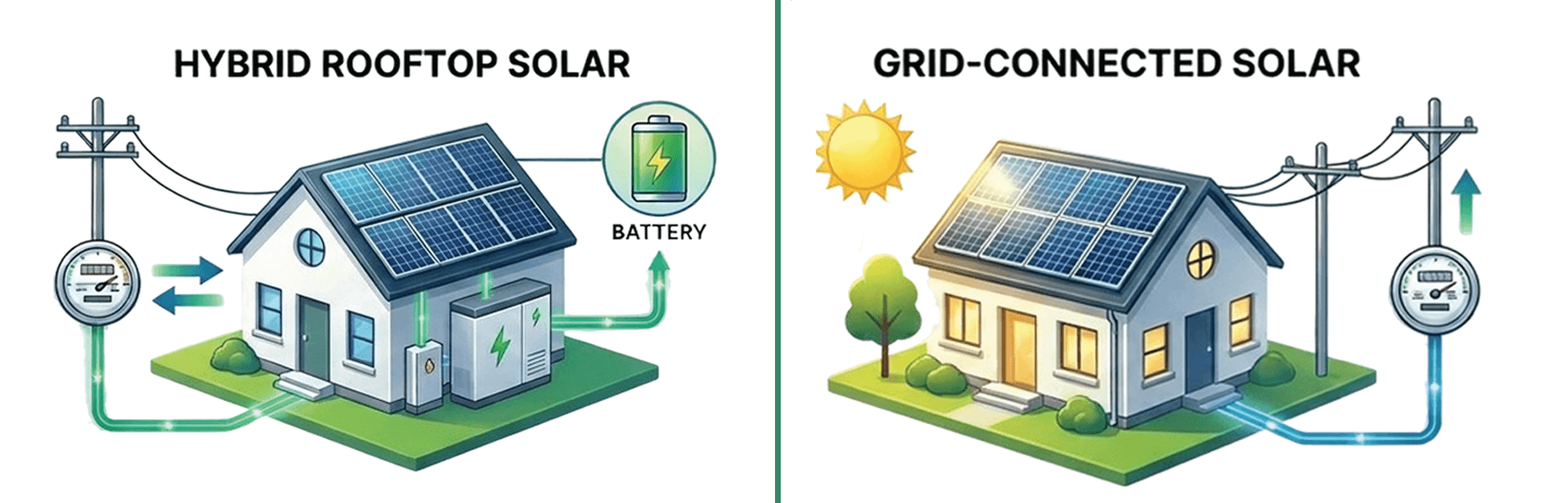
However, not all rooftop solar systems are created equal. Borrowers weighing grid‑connected vs hybrid rooftop solar face different realities in terms of upfront costs, savings, and loan structures. Let’s see why understanding these differences is necessary before signing a loan agreement.
Grid-Connected Rooftop Solar (The Mainstream Choice)
These systems are the most common in India. They conserve the collection of solar energy by feeding excess power back into the grid. Electricity is only drawn when solar generation is insufficient. For example, during nighttime hours, monsoon season, or peak demand periods, when industrial machinery consumes more than the solar system’s capacity.
Now, grid-connected systems may seem cheaper upfront. Although savings depend heavily on net metering policies and grid reliability. Let’s see the cost profile of such systems:
- Capital cost: ₹45,000–₹55,000 per kW.
- No battery storage: Lower upfront cost compared to hybrid systems.
- Subsidies: Under PM Surya Ghar Muft Bijli Yojana, households can get up to ₹78,000 subsidy for 3 kW systems.
The payback period for residential users is 4-6 years, whereas it’s much faster for MSMEs with higher tariffs. But again, be aware of savings as it relies on DISCOM efficiency and net metering policies, which vary by state.
Loan Impact
The loan size is smaller since batteries aren’t included. You can choose EV or solar loans from NBFCs like Ecofy and acquire grid-connected systems with reducing balance interest rates. Also, many banks waive collateral for loans under ₹2 lakh, especially for rooftop solar under government schemes.
Hybrid Rooftop Solar (The Resilient Alternative)
Hybrid rooftop solar systems bring together two energy sources, namely grid connectivity and batteries that store solar power. Such setups give you backup during outages. For example, when your local electricity provider faces power cuts due to broken wires or malfunctioning main circuits.
Let’s see the cost profile of this option:
- Capital cost: ₹85,000–₹1,10,000 per kW (2026 average).
- Battery cost: Lithium‑ion batteries add 40–50% to system price.
- Subsidies: Limited; most state subsidies focus on grid‑connected systems.
This dual-power system can be critical in states like Jharkhand and Bihar that often face power outages. Though it’s almost 2x the cost of grid-connected systems, it’s superior in reducing your bills and adding resilience against power cuts. What’s more, the payback period is 7-10 years due to higher upfront costs.
Also Read: New Year, New Savings: Smart Green Investments You Can Make In 2026
Loan Impact
Most borrowers may need larger financing of around ₹5–15 lakh in case of MSMEs. But luckily, many state schemes (like those offered by Gujarat’s Climate Change Department) give concessional loans for hybrid systems. That being said, you must remember that lenders label hybrid loans as high-risk. We can’t blame them since there’s always the factor of battery degradation.
Comparison Table Between Grid-Connected and Hybrid-Rooftop Solar Systems
Factor
Grid-Connected
Hybrid Rooftop Solar
Capital Cost (per kW)
₹45k–₹55k
₹85k–₹1.1 lakh
Batter Req.
No
Yes (adds 40-50% cost)
Subsidy Coverage
Strong (PM Surya Ghar, state EV/solar schemes)
Limited
Payback Period
4-6 years
7-10 years
Savings Dependence
Net metering efficiency
Both net metering +outage resilience
Loan Size
Smaller, easier approvals
Larger, higher risk
Best For
Urban households, MSMEs with stable grids
Rural/semi-urban areas with outages
Risks of Such Solar-Powered Systems
Here are some pointers to keep in mind:
- Policy uncertainty: Net metering rules differ across states; Tamil Nadu recently capped exports, and that reduces savings potential.
- Battery degradation: Hybrid systems face replacement costs every 7–8 years.
- Loan scams: RBI flagged over 500 suspicious loan apps in 2025–26, some posing as “solar loan providers.” Borrowers must verify lenders on the RBI’s registry.
Advice for Borrowers
Always audit your grid reliability. If outages are rare, you can choose grid-connected for its cost-effectiveness. Also, consider calculating payback amounts with our EMI calculator. Don’t forget to factor in subsidies and savings or loan interest. Lastly, be informed that the smartest borrowers will match their solar choices to the financial reality of their situation.
FAQs
1. How do rooftop solar systems affect property value in India?
Studies in 2025 by real estate consultancies show that homes with rooftop solar installations sell at a 4–6% premium, especially in metro cities where electricity tariffs are high. Hybrid systems add even more value due to backup capability.
2. Can MSMEs claim tax benefits on rooftop solar loans?
Yes. Under Section 80‑IA of the Income Tax Act, MSMEs investing in renewable energy infrastructure can claim deductions.
3. What happens if DISCOMs delay net metering credits?
Delays are common in states like Uttar Pradesh and Tamil Nadu. Borrowers should factor this into cash flow planning. Hybrid systems mitigate this risk by storing excess power instead of relying solely on DISCOM credits.
4. Are there risks of battery disposal in hybrid systems?
Yes. Lithium‑ion batteries require proper recycling. MNRE guidelines (2025) mandate safe disposal, and borrowers should check if their loan includes extended producer responsibility clauses for battery replacement.
5. How do loan EMIs compare to monthly electricity savings?
For a 3-kW grid‑connected system, EMIs average ₹3,000–₹3,500, while monthly bill savings are ₹2,500–₹3,000. Hybrid systems have higher EMIs (₹6,000–₹7,500) but also reduce diesel generator costs in outage‑prone areas.