
How EMI Structures Differ for EV2 vs EV3 Loans (And Why It Matters)
- Published on May 05, 2026
- Read Time 5 mins
-

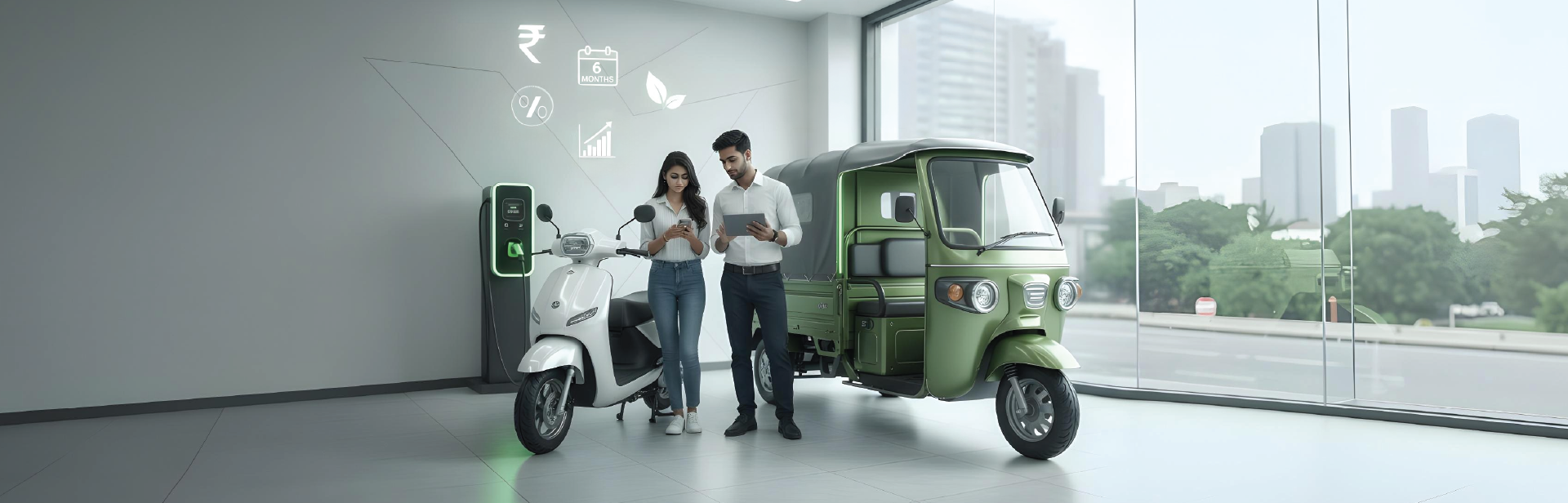
Whether you’re a delivery partner, daily 2-wheeler user, or a small fleet owner of 3-wheeler EVs, the EMI structure is the heartbeat of your EV loan payback plan. Paying the same EMI for a nimble delivery scooter and a heavy-duty cargo e-rickshaw wouldn’t ever make sense. That’s because an EV2W is often a “lifestyle + utility” purchase, whereas an EV3W could be used as a pure “earning machine.”
Green financers have switched away from rigid, old-school banking math. The concept of productivity-linked underwriting now sets EMIs based on how much a specific vehicle will earn for you daily.
Loan-to-Value (LTV) Ratios
You can get an LTV of 85%-95% for EV2W scooters and bikes. Their high-volume and standardized product nature makes green lenders comfortable in case of small down payments.
For e-rickshaws and 3W cargo vehicles, LTV often stay around 75%-85%. Since these vehicles undergo much higher “wear and tear” in commercial use, lenders can ask for a slightly higher down payment. This helps them offset the risk of the asset’s faster depreciation.
Tenure and “Economic Life”
Green EV loans for 2Ws usually range from 24-36 months. The idea is to keep the EMI low enough to compete with what a rider would have spent on petrol.
However, green loan tenures can be tighter for EV3Ws since they are revenue-generation assets. We’re looking at a range of 18-30 months, even more if the battery technology is top tier.
Simply out, lenders want the loan to be paid off while the vehicle is in its prime earning years. These years last before major battery degradation begins.
Also Read: EV Insurance Changes in 2026: What Should Borrowers and Insurers Prepare For
Daily vs. Monthly Psychology
EV2W EMIs are usually structured as a standard monthly instalment. It stays on par with ratios related to the monthly salary of professional or the monthly payout of a gig worker.
In the case of EV3W EMIs, many innovative lenders are now offering weekly or even daily collection models. Consider an e-rickshaw driver early money on a day-to-day basis, the large monthly EMIs could be hard to accumulate. Breaking it down into smaller, high-frequency payments matches their actual cash flow and prevents any EMI stress at the end of the month.
Total Cost of Ownership (TCO)
Lenders now factor in the TCO advantage specifically for EV3Ws. An e-rickshaw saves nearly ₹8,000 to ₹10,000 per month compared to a diesel or CNG equivalent.
A lender might approve a slightly higher EMI for an EV3W because they know your "fuel savings" effectively cover more than half of that instalment. This income-boost logic is rarely applied as heavily to personal EV2W loans.
Updated on Battery-as-a-Service Model
The biggest shift this year is the decoupling of the battery from the vehicle loan.
- If you opt for battery swapping, your loan amount (and thus your EMI) drops by in a range of 20-60%.
- Instead of a high EMI, you pay a lower vehicle EMI plus a "pay-as-you-go" battery subscription. This is becoming the gold standard for EV3W fleets to keep daily overheads razor thin.
Also Read: Battery Swapping vs. Charging Stations: What’s More Bankable?
FAQs
Which loan is "easier" to get approved?
EV2W loans are generally faster because they are treated similarly to consumer durables. EV3W loans require more "proof of business" such as your delivery route, tie-ups with e-commerce platforms, or your permit details. However, if you have a strong earning path, EV3W loans often come with more customizable repayment terms.
Can I use a personal EV2W loan for commercial delivery?
You can, but it’s a mistake. A specialized Commercial EV2W loan often includes better insurance for delivery risks and might offer "stepped-up" EMIs (lower payments in the first few months while you scale your work).
Do both categories of EV2W and EV3W get the same interest rates?
Not necessarily. EV3W rates can be slightly higher due to the "commercial risk," but this is balanced by the fact that the vehicle pays for itself. EV2W rates are highly competitive and driven by your personal credit profile.