
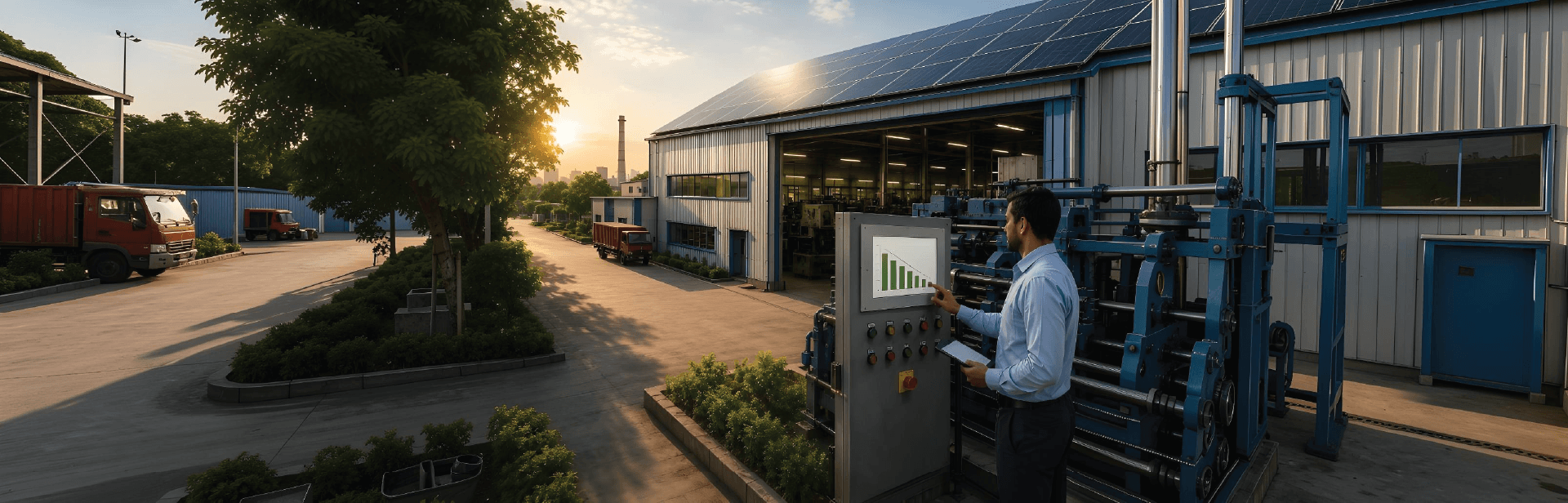
How an SME Reduced Power Costs by 33% & Improved Cash Flow (Case Study)
- Published on Apr 20, 2026
- Read Time 7 mins
-

Indian SMEs are increasingly looking at utility bills as a growing tax on their monthly profitability. While raw material costs keep fluctuating, electricity grid tariffs have a relentless upward trend that often reduces the margins reserved for business expansion.
For example, as per India Energy Exchange (IEX), electricity priced at ₹3.89/unit increased to ₹4.43/unit because of seasonal demand and supply-side shifts. This 13% price hike is data recorded for a single month. Most energy experts would agree that this pattern of spikes in energy costs is proportional to a direct decline in business productivity.
Similarly, electricity prices remain a high constraint for growth in industrial hubs like Maharashtra and Karnataka. For instance, Karnataka’s commercial and industrial (CNI) users recently faced tariff revisions as high as 95 paisa/unit, affecting their utility revenue shortfalls.
Our client, Dhanlaxmi Agro Industries, a specialist in irrigation drip pipe manufacturing, reached a tipping point where their energy spend hit ₹15 lakh/month. They realised that continuing to rely 100% on the grid was no longer a viable financial strategy. By partnering with Ecofy and Swid Renewables Ltd, they transformed their rooftop into a high-yield financial asset.
Let’s see how a 400kW rooftop solar (RTS) system helped this CNI category enterprise with its energy management issue.
Problem = A Limit to Profit Growth
Manufacturing heavy-duty irrigation equipment and machinery is an energy-intensive process. Operating out of Solapur, Maharashtra, Dhanlaxmi Agro Industries faced a consistent operational hurdle as a high-tension (HT) industrial consumer:
- Volatile Overheads: With monthly bills fluctuating between ₹12 lakh and ₹15 lakh, the business struggled with long-term financial forecasting. Every time the grid tariff was revised, their cost per unit of pipe produced increased and compromised their existing competitive edge.
- The "MSME Energy Tax": In industrial hubs like Solapur, energy is often the single largest controllable expense. For Dhanlaxmi, these costs were capital being "burnt" rather than reinvested in raw materials or workforce expansion.
- Operational Risk: Relying solely on the grid meant that their production costs were at the mercy of state utility revenue shortfalls and global fuel price shifts.
Also Read: Digital MSME Lending in 2026 (AI, APIs, and Instant Approval)
Solution = 400 kW RTS CNI Strategy
The leadership at Dhanlaxmi Agro decided to move from a "consumer" mindset to a "producer" mindset for better energy cost efficiency. They commissioned a 400 kW Rooftop Solar (RTS) system, a strategic scale for CNI operations. Swid Renewables Ltd handled the implementation, but the critical financial catalyst and MSME green financer was Ecofy. Here’s what the core benefits were:
- Preserving Working Capital: Rather than depleting their cash reserves to pay for the system upfront, Dhanlaxmi utilised Ecofy’s specialised green financing.
- The "Ecofy Journey": Kiran Parade, owner of Dhanlaxmi Agro, noted that the process was "simple and supportive," allowing the business to modernise its energy infrastructure without the typical bureaucratic hurdles of traditional commercial loans.
Result = Immediate and Compounding ROI
The financial shift was almost immediate. Since the 400kW system went live, the factory’s financial profile has been working in the direction of higher profit margins.
Metric
Before Solar
After Solar
Financial Impact
Avg. Monthly Bill
₹12–15 Lakh
₹8–10 Lakh
~33% Reduction
Monthly Savings
-
₹5 Lakh
₹60 Lakh Annual Growth Fund
Payback Period
-
2–3 Years
Rapid Asset Recovery
Note: Lowering their fixed costs has helped them create a monthly dividend of ₹5 lakh.
Also Read: Green MSME Loans (How Sustainability Turns a Cost Centre Into a Growth Lever
33% Reduction in Monthly Electricity Costs
The success of Dhanlaxmi Agro Industries proves that solar is a "value booster" for Indian SMEs. After a short 3-year payback period, the electricity generated will be virtually free for the remainder of the system’s 25-year lifespan.
Kiran Parade (Dhanlaxmi Agro)
"Our experience with Ecofy was very positive. The team supported us throughout the financing journey. I would definitely recommend solar to other businesses as it is a smart investment for the future," says Kiran Parade.
As industrial tariffs continue to climb, the question for manufacturers has shifted from the technology's cost and environmental efficiency to its impact on supply chains. The real question should be, "How much capital are they willing to lose by staying on the grid?"
CTA: Apply for an SME Green Loan
FAQs
Does Ecofy offer collateral-free solar loans?
Yes. Ecofy provides specialised green loans that focus on the asset's cash-flow potential. Many MSME loans are designed to be collateral-free to help small businesses scale without risking existing property.
How does the current IEX power price surge affect my business?
With spot prices on the Indian Energy Exchange (IEX) fluctuating (recently jumping 13% in a single month), staying 100% grid-dependent makes your production costs volatile. Solar acts as a "fixed-cost" hedge, protecting your margins from these market spikes.