The Real Difference Between “Eligible” and “Affordable” Loans (With Traps to Avoid)
- Published on Jul 22, 2026
- Read Time 7 mins
-

You check your credit score, and it’s an impressive 780. You apply for a ₹1,50,000 electric scooter loan, and within 10 minutes, the screen shows, "Congratulations! You’re eligible for a 100% on-road funding loan." You celebrate.
However, reality hits hard three months later. Your monthly EMI is eating up 35% of your take-home pay. The unexpected “documentation fees” just drained your weekend budget. Suddenly, that “approved” and “eligible” loan seems like a financial trap.
Remember that in Indian retail finance, being eligible for a loan doesn’t mean you can afford it. Understanding this boundary is the secret to stress-free green financing.
The Core Difference
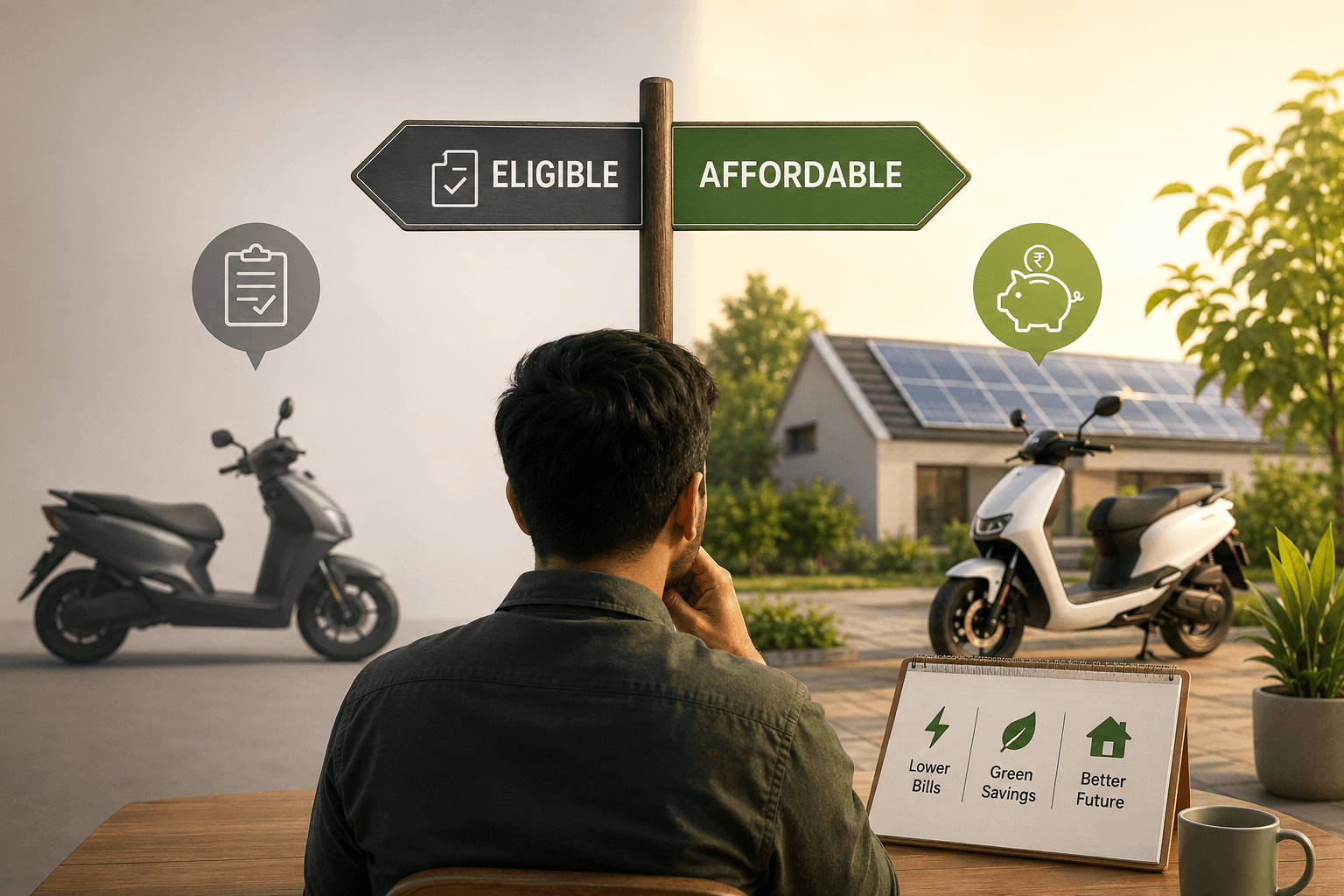
Here’s the deal. Eligibility is about the bank’s risk, but affordability is about your monthly income situation.
- Loan eligibility: This is the lender’s math. They look at your CIBIL score and whether your income is stable. Age is another factor they fit into their criteria. All they need is an answer to, “Will we get our money back?”
- Loan affordability: This is your math. It will consider your rent, grocery bills, existing EMIs, emergency funds, and your lifestyle choices. You need to answer one simple question, “Can I live comfortably while paying this green loan back?”
Tip: The golden rule of green EMIs states that your total monthly EMI payouts, including your new EV or solar loan, should never cross 30% of your net monthly income.
You can use this table to compare these two concepts side-by-side when choosing a green asset loan.
| Feature | Loan Eligibility | Loan Affordability |
| Primary Driver | Credit history, CIBIL, and salary slips | Real-time cash flow, savings goals, and daily expenses |
| Formula Used | Fixed obligation to income ratio (FOIR) | Net monthly surplus after all fixed and variable costs |
| Flexibility | Highly strict, rule-based, and algorithmic | Dynamic and changes with lifestyle and inflation |
| Asset View | Looks at the purchase price of the asset | Looks at the Total Cost of Ownership (TCO) over time |
| Risk Focus | Protects the bank from non-performing assets | Protects your family from financial distress |
Also Read: How Can Rooftop Solar Loans Help MSMEs Scale?
How Appraisals Have Changed (Old Vs New)
It gets better. Forward-minded green lenders start by looking at what you earn today. But the more digitised your green lender, the more they use AI underwriting and alternative cash-flow data to decide your creditworthiness for eco-friendly upgrades. Also, while traditional banks only assessed your past credit history and salary slips, modern NBFCs don’t require high upfront down payments and instead offer 90-100% on-road asset funding.
In short, traditional banking models penalise borrowers who lack a deep credit history, even if they have excellent cash flows. However, modern green financing fixes this by factoring in the long-term savings of the asset itself.
Traps That Can Affect Your Loan Affordability
You might look perfectly eligible on paper, but these three hidden variables in the Indian lending industry can harm your monthly budget:
1. Fixed vs Reducing Interest Rate Trap
A 9% "flat" rate sounds significantly cheaper than a 14% "reducing" rate, right? Wrong. Flat-rate loans charge interest on the original principal for the entire tenure of the loan, regardless of how much you have already paid back. Always look past the marketing and ask for the effective reducing rate.
Also Read: Understand Flat Rate vs. Reducing Balance Rate in 2026
2. Processing, Documentation, and Foreclosure Fee Blow
Many borrowers focus exclusively on the EMI and ignore the fine print. Upfront processing fees (which can go up to 3%) and steep foreclosure penalties (up to 6% if you want to close the loan early) can add thousands of rupees to your total cost.
3. Long Tenures That Increase Total Interest
Opting for a 5-year tenure instead of a 3-year tenure will drop your monthly EMI significantly. And the catch? It makes the loan look instantly affordable on day one. However, the extended timeline means you end up paying nearly double the total interest to the lender across the loan period.
FAQs
Can I be eligible for a loan but still unable to afford it?
Yes. Eligibility is based on the bank's risk rules. Affordability depends entirely on your personal monthly savings, expenses, and lifestyle choices.
How does an EV or solar loan improve my true affordability?
An Ecofy EV or rooftop solar loan helps you invest in assets that reduce your monthly fuel and electricity bills. These long-term savings can offset a part of your EMI, making your loan more affordable while lowering your overall cost of ownership.