
The True ROI of Rooftop Solar: How Financing Makes It Affordable
- Published on Nov 30, 2025
- Read Time 7 mins
-

Most Indian households and businesses understand that solar saves money. Concern about this technology’s efficiency doesn’t interrupt their decision to switch. It's mainly the lump-sum cost that delays their solar setups. When green financing removes that barrier, eco-friendly energy adoption jumps and real ROI becomes visible. Remember, solar financing only accelerates how soon you start earning those returns.
Why ROI Matters More Than Upfront Cost
Rooftop solar is one of the few home upgrades that pays you back over time. A typical system lasts 25 years or more, meaning you’ll enjoy 18-20 years of reduced electricity bills after the typical payback window of 3 to 6 years.
For a 3-5 kW residential system, annual savings often fall between ₹12,000 and ₹30,000. And homes with higher consumption save even more because they offset the costlier slabs of power tariff. In short, solar gives you the equivalent of long-term passive income from reduced electricity bills.
Why Indians Hesitate Despite Strong Savings
The hesitation and mental barrier against solar products and solar loans come from three India-specific realities:
- Electricity bills vary sharply across states. Households and businesses in Maharashtra, Karnataka, Telangana, and Delhi pay far higher unit rates than those in Gujarat and Rajasthan. This changes how people perceive savings.
- Indian businesses and families are liquidity-conscious. Large one-time spends like ₹80,000 to ₹1.5 lakh feel heavy even when long -term gains are quite strong.
- Net-metering rules differ by state. Some allow banking (how long you can store units) till only the same billing cycle, whereas others revise policies every year. This uncertainty leads households to postpone decisions.
Bonus Read: Smart Homes, Lower Bills: How Technology Can Cut Your Utility Bills
The Actual ROI of Rooftop Solar in India
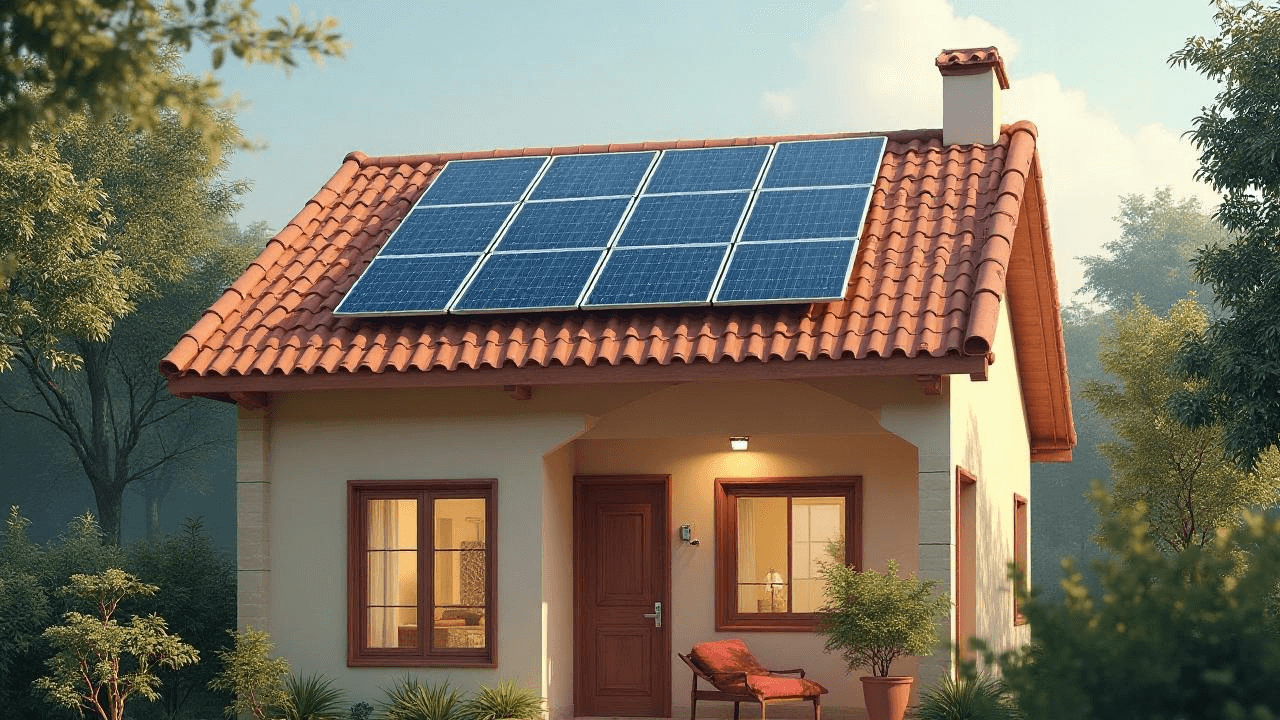
Your solar system’s size, local sunlight exposure, and tariff slabs can tweak the numbers mentioned above. Nonetheless, core savings are consistent.
Let’s now assume a typical middle-income home installs a 3 to 5 kW system:
- Cost: ₹1.2 to ₹2 lakh, depending on panel quality and brand
- Monthly savings: ₹1,500 to ₹3,500 in high-tariff states
- Payback: 3.5 to 5 years without subsidy
Hidden ROI Most People Often Overlook
Here’s what convinces most homeowners and business owners to invest in solar setups:
1. Protection from tariff hikes
Electricity prices in India rarely stay stable. Discom losses, rising fuel costs, and infrastructure upgrades push tariffs upward every one to two years. Thus, a solar setup lets your power costs stay stable for decades.
2. Higher returns than fixed deposits
FDs deliver roughly 6-7% post-tax returns. Solar offers 12-20% annualised ROI after payback. This is one of the most stable, risk-free returns in an Indian household.
3. Boost in property value
Homes or business premises with solar installations often attract buyers faster. The next owner inherits low electricity bills for two decades. This creates tangible resale value.
4. Long lifespan with minimal maintenance
Modern solar panels need cleaning and basic upkeep. Most inverters come with multi-year warranties. Over a 25-year period, maintenance costs are minimal compared to recurring electricity bills.
Green financing lets households switch to solar without touching savings. Your EMIs can equal your electricity bill. If your bill is ₹2,000 to ₹3,500, your EMI for a financed solar system often matches this number. Your monthly cash flow stays the same, and once the loan ends, your electricity bill stays low for the next 20 years.
Get quick approvals with green-focused lenders like Ecofy. As a green-only NBFC, Ecofy assesses climate-positive assets differently from regular loans.
Indian Solar Economics That Strengthen Savings
Indian households stand to benefit more from solar due to several local realities.
- Heavy daytime load: Many homes now run air conditioners, water pumps, fridges, and coolers during the day. Solar fits this load perfectly and reduces grid dependence.
- Work-from-home lifestyle: Families spending more time at home consume more electricity during sunlight hours. Solar reduces these peak loads.
- Discom instability: In states where grid quality fluctuates, solar paired with a small backup system provides a reliable power supply.
- Subsidy support: Central and state-level subsidies further reduce system cost. Even without a subsidy, financing keeps the adoption barrier low.
Bonus Read: What’s Common Between Your Credit Score and Carbon Score?
Why Ecofy Improves ROI for Indian Households
Ecofy’s model is built specifically for EVs, rooftop solar, and green MSMEs. You can get added value through small-ticket loans tailored for residential solar. Partnerships with trusted installers like Tata Power Solar and Waree, including a super-fast digital onboarding process, give you access to green-focused capital pools that keep EMIs competitive.
Verdict
The returns stay the same. Financing simply makes your journey towards solar consumption much simpler.
CTA: Speak to an Expert at Ecofy
Without financing
Upfront cost: ₹60-75k per kw
Annual savings: ₹15,000 to ₹35,000
Payback: 3 to 6 years
Net gain over 25 years: ₹4 to ₹6 lakh
With financing
Upfront cost: 10% of the total cost
EMI: Similar to current electricity bill
After loan, savings continue for 15 to 20 years
Net gain over 25 years: ₹4 to ₹6 lakh
Cash flow impact: Minimal or zero
FAQs
How long does it take to recover the cost of a rooftop solar system in India?
Most Indian homes recover the cost in three to six years. Homes with high monthly bills recover costs faster.
Can my rooftop solar EMI be equal to my electricity bill?
Yes. For many households, the EMI for a financed solar system falls in the ₹1,800 to ₹3,500 range. This is usually equal to what you already pay your discom. After your loan ends, your electricity bills drop for the next 15 to 20 years.
How does net metering affect my solar savings?
Net metering lets you send extra electricity back to the grid and get credits. This lowers your overall bill. States have different rules, so your savings depend on how your state handles banking hours, compensation rates, and unit carry-forward.
Does rooftop solar increase my property value?
Yes. Homes with solar installations can sell faster because buyers prefer lower electricity bills for the next 20 to 25 years. It becomes a long-term value addition to the property.