
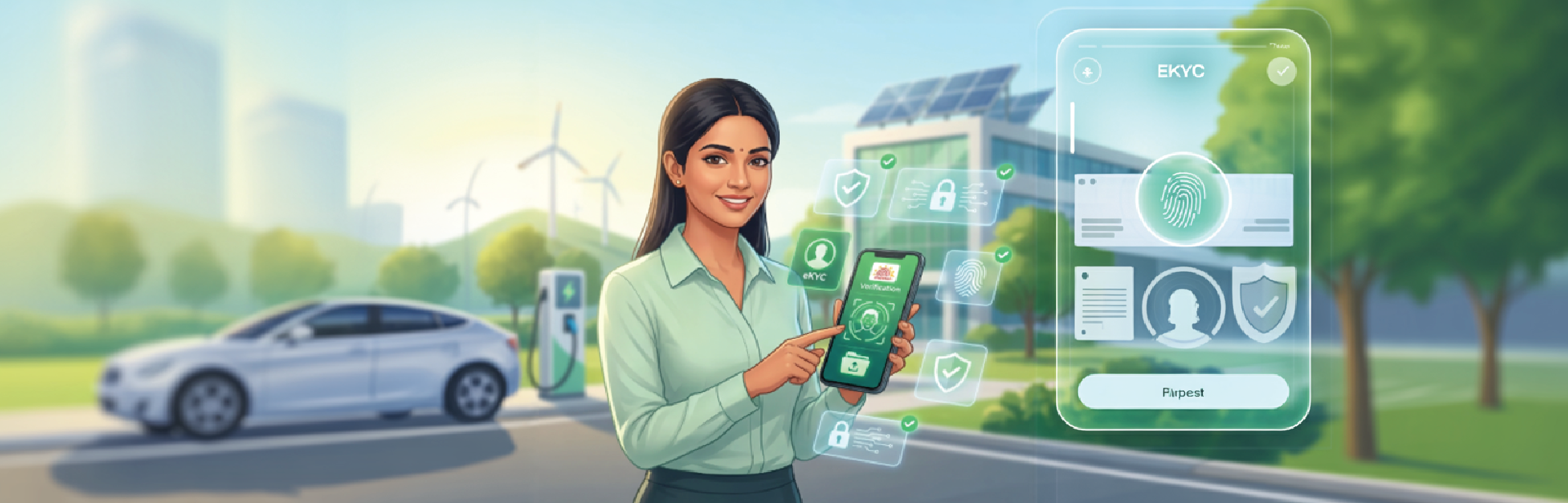
Understanding eKYC and Digital Verification for Green Loans: How It Protects You
- Published on Mar 27, 2026
- Read Time 5 mins
-
Are you ready to apply for a solar rooftop loan or finance an EV fleet? You’ve probably done the math, calculated your energy savings, and checked for subsidy eligibility. However, you also need to verify your or your company’s identity through digital KYC to obtain the necessary approvals.
India’s high-volume credit ecosystem has zoomed past the era of dozens of photocopies and long queues. It’s now about eKYC (electronic Know Your Customer) and digital verification. Consider this process the invisible gatekeeper that decides whether your loan is approved in minutes or stuck for months.
Whether you’re an MSME or a household owner applying for a green loan, eKYC is your ticket to protection against fraud. It’s also your guarantee that subsidies reach the right account and that you’re in sync with RBI’s 2025-2026 compliance mandates.
What Exactly is eKYC?
eKYC is the digital process of verifying identity using Aadhar and government-linked databases. Its paper-free approach makes it much quicker, safer, free of manipulation, and considerably more transparent than traditional KYC methods. Here are the types of eKYC in India’s green loan market:
- Aadhaar OTP eKYC: Quick verification via mobile OTP linked to Aadhaar. Perfect for smaller loans and fast onboarding.
- Biometric eKYC: Fingerprint or iris scan for high-risk or large loan amounts. Ensures physical identity matches records.
- Video KYC (VCIP): Real-time video verification to confirm identity and presence. Widely adopted by green NBFCs and fintech lenders.
- DigiLocker Integration: Secure sharing of GST, PAN, and utility records without photocopies. This drops the possibility of fraud risk.
- CKYC (Central KYC Registry): Uses a 14-digit CKYC number to fetch previously verified KYC data from a central repository.
How Does eKYC Help Green Loans?
Here are some ways eKYC can make your experience of acquiring a solar rooftop loan, MSME loan, or EV-2 wheeler or 3-wheeler EV loan much easier:
Faster Approvals
- Rooftop solar loans can now be processed in very less time instead of taking weeks.
- EV fleet operators benefit from instant verification, and this is critical when subsidy deadlines are tight.
- The August 2025 Amendment formally introduced Aadhaar Face Authentication as a valid digital verification method.
- Real-time CKYCR is integrated under the updated 2025 Directions. NBFCs can achieve near-instant approval by downloading existing customer records from the Central KYC Records Registry (CKYCR).
Also Read: What to Do if You’re Struggling to Repay Your Loan
Fraud Protection
- Video KYC helps prevent impersonation (a growing issue in loan scams).
- OTP verification blocks fake apps from misusing borrower data.
- UIDAI’s 2026 upgrade introduced multi-factor authentication to combine OTP with biometric checks.
Subsidy Alignment
- Subsidies under PM Surya Ghar Muft Bijli Yojana and state EV policies are Aadhaar-linked.
- eKYC ensures funds are credited directly to verified accounts, thereby avoiding cash leakage.
- MSMEs can track subsidy disbursements via the MNRE portal to avoid delays.
Risks Without eKYC
The lack of proper digital verification could burden an MSME with loan app fraud, identity theft, subsidy delays, and higher processing costs that strain cash flow. It’s recommended to always apply through RBI-registered lenders and trust Aadhaar OTP or DigiLocker instead of scanned documents. Furthermore, only track your subsidy credits through MNRE’s portal.
Also Read: EV Insurance Changes in 2026
FAQs
1. Can subsidies be combined with co-lending loans?
Yes. In co-lending models, banks and NBFCs can jointly finance MSMEs, and subsidies are still credited directly to the borrower’s Aadhaar-linked account.
2. Do subsidies reduce interest rates?
Not directly. They reduce the principal, which lowers EMI amounts. Some NBFCs, however, offer concessional rates for verified green loan borrowers.
3. What happens if subsidy disbursement is delayed?
Borrowers must continue servicing EMIs. Smart lenders structure loans so that once subsidies arrive, they are deducted from the outstanding principal.
4. Are MSMEs eligible for both solar and EV subsidies?
Yes. MSMEs can stack subsidies if they adopt multiple green technologies, provided each application meets MNRE/state guidelines.
5. How do subsidies affect payback periods?
For rooftop solar, subsidies can shorten payback by 1–2 years. For EV fleets, upfront subsidies reduce purchase costs and make EMIs more manageable from day one.