
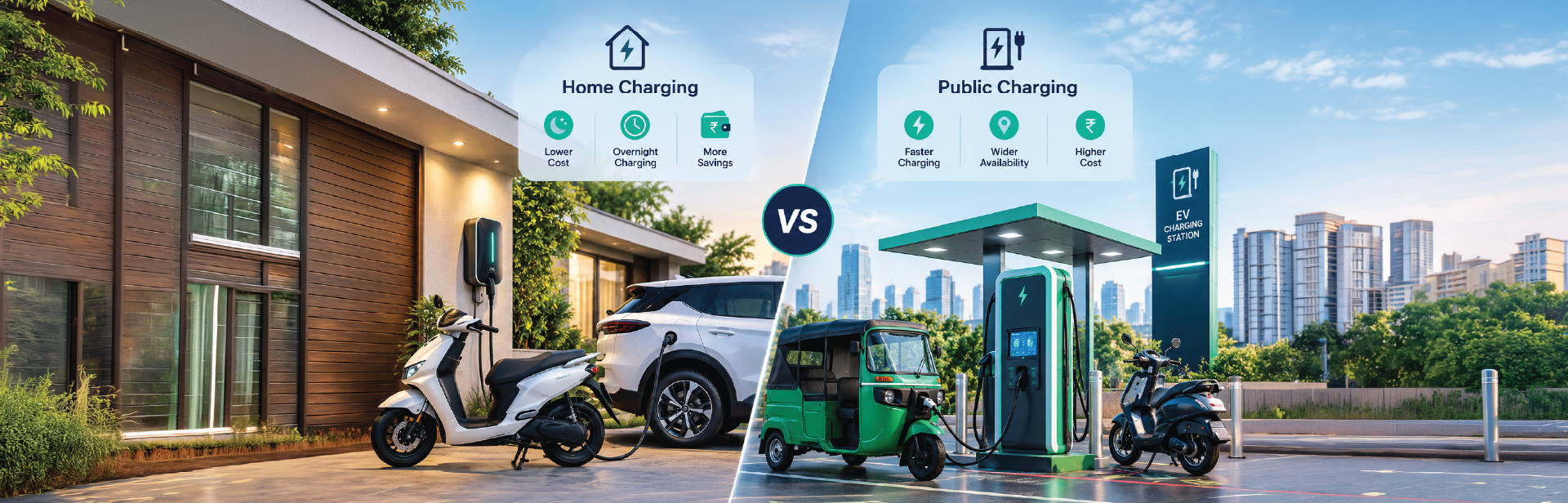
Charging Your EV at Home vs Public Stations: Cost Comparison
- Published on Oct 06, 2026
- Read Time 7 mins
-

Did you know that where you plug in will decide whether you save 60% or up to 85% of your EV’s monthly running expenses? Most users are aware that moving to an EV drops per-kilometre operating costs compared to diesel or petrol. However, few realize the collective amount that can be saved via location-based per-unit electricity tariffs.
The debate between home charging and public fast-charging is a high-value financial decision for commercial and everyday EV drivers.
Let’s dig in.
Tariff Structures Explained
The primary reasons for this cost gap between charging EVs at home and at a public setup are grid access and service markup.
- Home Charging (AC Level 1/Level 2): You pay standard domestic electricity tariffs set by your state DISCOM when charging an EV through in-house electricity. This rate varies from ₹6.00 to ₹8.00 per kWh/unit. Certain states also offer specialized EV tariffs or time-of-day (ToD) rebates that can drop off-peak night tariffs even lower.
- Public Charging Stations (DC Fast Charging): High capital expenditure for heavy-duty EV charging equipment and land costs, along with higher commercial electricity tariffs, tend to increase the costs for public EV charging operators. The pricing for public DC fast charging can vary from ₹18.00 to ₹24.00 per kWh/unit, plus GST and session fees.
Real-World Cost Comparison
Try to do a cost assessment. Let’s assume you have an EV 2-wheeler or an L5 electric 3-wheeler running 2,500 km per month. Also, keep an average efficiency value of approx. 10 km per kWh.
Charging Parameter | Home AC Charging | Public DC Fast Charging |
Electricity Tariff | ~₹7.00 / kWh | ~₹20.00 / kWh |
Monthly Energy Required (2500 km) | 250 kWh | 250 kWh |
Total Monthly Charging Cost | ~₹1,750 | ~₹5,000 |
Cost Per Kilometer | ~₹0.70 / km | ~₹2.00 / km |
Result: Compared to relying solely on public DC fast chargers, it’s clear that if you rely exclusively on home AC charging, savings can be approx. ₹3,250/month and over ₹39,000 annually.[a]
Also Read: Simple Comparison of EV-2W Running Cost Vs Petrol Scooter Cost
Hidden Variables That Impact Your Final Bill
Two key technical factors influence your actual cost per kilometre beyond the baseline tariff per unit:
Charging Efficiency and Thermal Losses
AC home charging functions at a higher efficiency with minimal heat build-up. Contrarily, high-kW DC fast charging might generate much more thermal stress and cause your vehicle’s battery management system to react. This could mean cooling fans pushing at a higher speed and thermal loops running at full capacity during the session.
This parasitic power draw can lead to 10% to 15% energy loss. In simpler words, you pay for units that never reach the battery.
Long-term Battery Health (SoH)
Frequent DC fast charging will quicken your EV’s battery degradation rate because of continuous heat and chemical stress on lithium-ion cells. If you take a 3–5-year EV green loan, preserving your battery’s State of Health (SoH) via slow AC charging prevents premature range loss within that tenure. Even better, it protects your EV from a large drop in resale value.
Choose a Smart Hybrid Charging Strategy
Don’t worry about choosing exclusively between the two. Opt for the 80/20 framework rule. Use 80% of your charging time to handle your daily baseline range via slow AC charging overnight (11 PM to 6 AM), when electricity demand and ambient temperatures are lowest. Reserve the 20% for public DC fast chargers for strict emergency top-ups or mid-shift route extensions.
CTA Button: Finance Your EV with Ecofy[b]
FAQs
Can I install a dedicated EV meter at home in India?
Yes. Most state electricity boards (DISCOMs) now allow residential consumers to apply for a separate EV charging meter. In many states, these meters come with subsidised EV tariffs to encourage off-peak charging.
How long does it take to recover the cost of setting up a home AC charger?
Most electric 2-wheelers and 3-wheelers come with portable AC chargers included. If installing a dedicated 7.2 kW home wallbox (costing ~₹25,000–₹35,000), the monthly savings compared to public fast-charging offset the installation cost within 8 to 10 months.
Also Read: EV Fleet Management Lessons from Businesses That Switched from Fuel to Electric
[a]Use key takeaway box here
[b]Use CTA button