
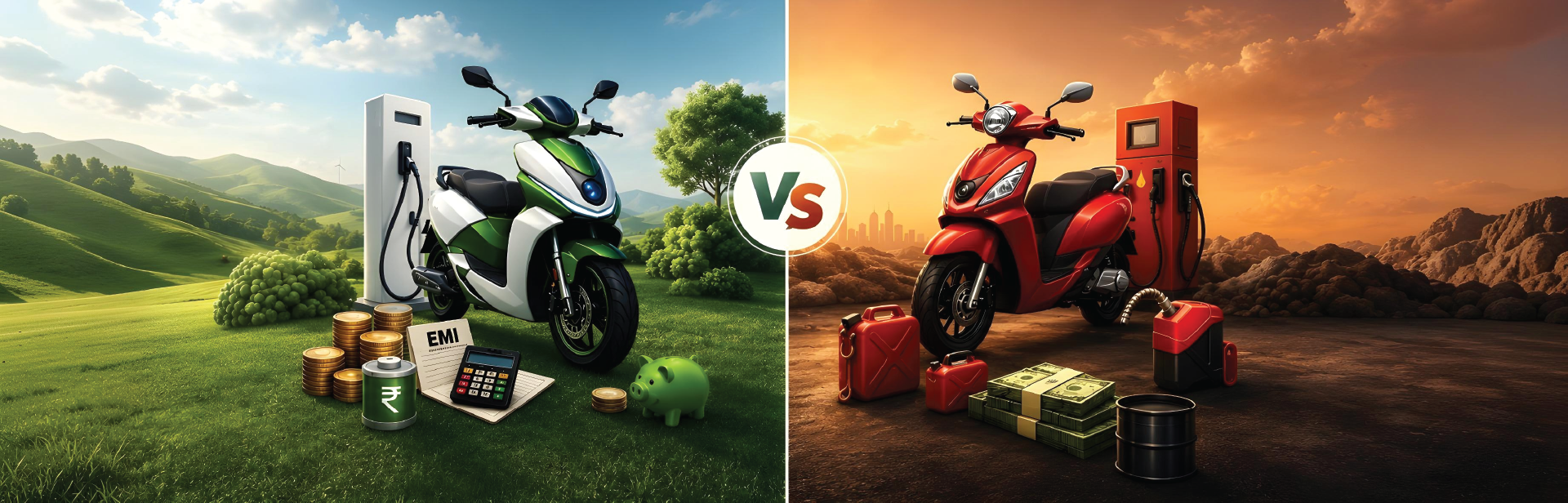
Simple Comparison of EV-2W Running Cost vs Petrol Scooter Cost
- Published on Jul 18, 2026
- Read Time 5 mins
-


Most people compare electric and petrol 2-wheelers based on showroom prices. But the actual cost shows up after you start riding daily. An EV-2W may cost more upfront, but its daily running cost is usually much lower because electricity is cheaper per kilometre than petrol.
Petrol prices in major Indian cities are still above ₹100/litre in many areas, with Delhi at around ₹102/litre and Mumbai at around ₹111/litre in June 2026. So if you ride 25-50 kms daily, the cost gap between an EV-2W and a petrol scooter becomes visible within the first month itself.
How Much Does an Electric 2-Wheeler Scooter Cost Per Kilometre?
Let’s use a simple example. A popular EV may have a battery capacity of 2.2-4.7 kWh and offer a certified range of 94-175 km, depending on the model variant. TVS iQube, for example, lists 2.2 kWh, 3.1kWh, 3.5 kWh, and 4.7 kWh variants with an IDC range from 94 km to 175 km.
Also, note that India’s residential electricity price was around ₹6.49/kWh in September 2025, while business electricity was around ₹9.89/kWh. So, if your EV scooter uses a 3 kWh battery and gives around 100 km of practical range:
Charging cost = 3kWh x ₹6.5 = ₹19.5
Running cost = ₹19.5 / 100 km = ₹0.2/km
Even with charging losses and higher electricity rates, many electric scooters can still stay roughly around ₹0.25 to ₹0.60 per km for home charging.
Also Read: What Lenders Assess When You Apply for an EV Loan
How Much Does Petrol Cost Per Kilometre?
Let’s now do a similar math for petrol scooters.
Consider the price of petrol as ₹105/litre. With an optimistic mileage of 45 km/litre, the running cost of a petrol EV-2W is ₹2.33/km. Similarly, if petrol is ₹110/litre and your scooter gives 40 km/litre in traffic, your running cost becomes:
Running cost = ₹110 / 40 km = ₹2.75/km
This calculation clearly shows how a petrol scooter often costs 7 to 10 times more per kilometre than an EV-2 wheeler. Keep in mind that your city, traffic, mileage, and charging infrastructure all influence the running costs considerably.
Monthly Cost Comparison for an EV-2W and a Petrol Scooter
The base assumption we’ll consider is that you ride 30 kms per day, or roughly 900 kms per month.
| Vehicle Type | Approx. Cost Per Km | Monthly Running Cost |
| Electric 2-wheeler | ₹0.2 - ₹0.4/km | ₹180 - ₹360 |
| Petrol scooter | ₹2.5 - ₹2.75/km | ₹2250 - ₹2475 |
Overall, your monthly savings could be around ₹1,890 and your annual savings around ₹22,680.
Also Read: How EMI Structures Differ for EV2 vs EV3 Loans
Simple Breakeven Mindset
Suppose an electric scooter costs ₹20,000 more than a comparable petrol scooter.
If your monthly savings are around ₹1,800, your running-cost breakeven is returned in roughly:
₹20,000 / ₹1,800 = 11 months
If your monthly savings are only ₹700, breakeven may take more than 2 years. So, the right question is only, “Is an EV or petrol scooter better?”
Instead, you should get an estimate of how much you ride, where you will charge the electric scooter, and what EMI amount you can manage comfortably.
Should I Buy an Electric Scooter on EMI?
Many buyers shy away from paying the entire amount up front. That is where EV-2W green loans can make your switch much easier.
Ecofy focuses on green finance across segments, including electric two-wheelers, electric three-wheelers, rooftop solar and SME loans. What’s best, a retail-first digital financing approach ensures that your repayment schedule is convenient enough to enjoy the cost-saving benefits and worry less about piled-up interest.
FAQs
Can I get lower interest rates on loans specifically for buying electric scooters?
Yes. Many financial institutions like Ecofy offer specialised "Green Loans" for electric two-wheelers, which often feature lower interest rates and faster digital processing compared to standard vehicle loans.
How does commercial charging at a business location affect EV running costs?
Commercial electricity rates are roughly 50% higher than home rates (around ₹9.89/kWh vs ₹6.49/kWh), which raises your EV running cost but still keeps it significantly cheaper than petrol.
How much does it cost to fully charge an electric scooter battery at home?
A standard 3 kWh battery costs about ₹20 to ₹30 per full charge, depending on your local residential electricity slab rates.