
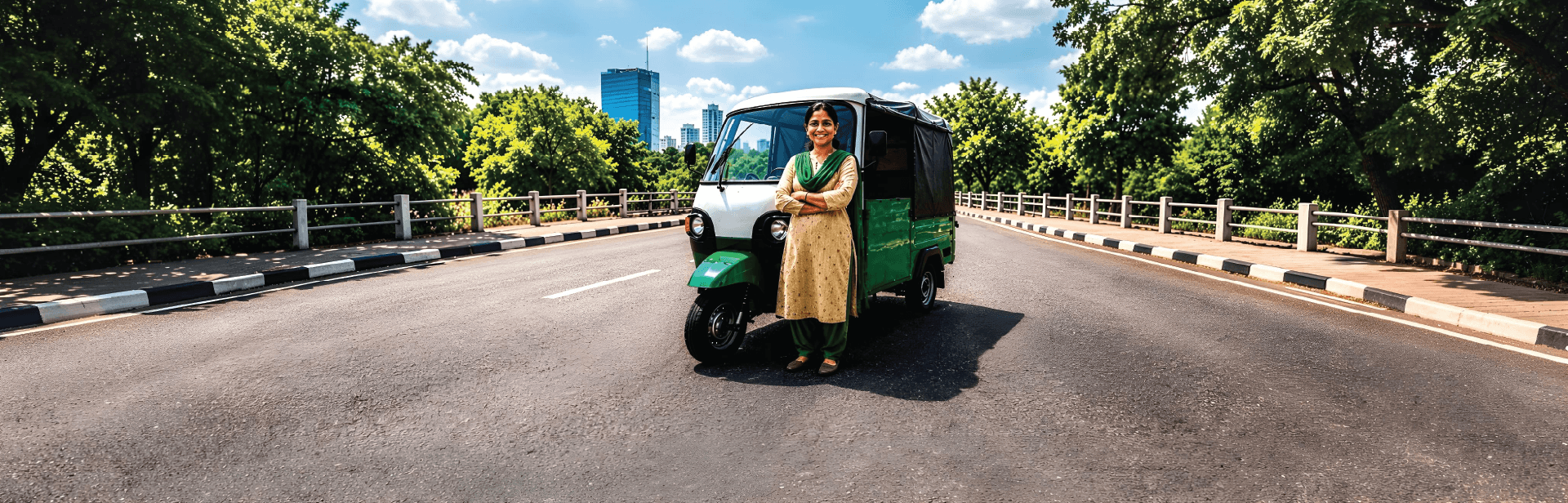
EV 3-Wheeler Loans for Women Entrepreneurs: Benefits & Schemes
- Published on Feb 18, 2026
- Read Time 7 mins
-

For as long as three-wheelers have existed, the market has been dominated by men. There’s been little to no existence of women driving or owning these vehicles. But as we move toward liberal views and the voice of gender equality becomes more prominent, women on all fronts have stepped in and now participate at higher rates.
For example, Delhi’s crowded lanes and Maharashtra’s industrial areas are seeing women rickshaw drivers stepping into the driver’s seat in electric three-wheelers. Backed by subsidies and concessional loans, along with a loud demand for clean transport, EV rickshaw loans have become passports to independence and income for many women.
Why EV 3-Wheeler Green Loans are Helpful for Women?
Women entrepreneurs from small towns may find 3-wheelers to be practical, affordable, and profitable. Despite a lower upfront investment than cars or vans, they can still earn through:
- Passenger rides
- Last-mile delivery
- Logistics contracts with local businesses
This is possible since electricity as a fuel source dramatically reduces operating expenses in comparison to petrol or diesel. Many targeted state-level and national subsidies have dropped this entry barrier even more.
Moreover, EVs have enabled many women to participate in the economy on their own terms. And that too with vehicles that are sustainable and increasingly respected as viable business assets.
For women rickshaw drivers, the biggest relief is predictable daily savings. Charging an EV costs far less than refuelling with petrol or diesel, which means more of the fare stays in their pocket.
Also Read: EV Insurance Changes in 2026
Key Subsidies and Incentives for Women in 2026
While direct central subsidies are tapering off, states are showing up with targeted programs:
State-Specific Subsidies (Gujarat and Goa)
Gujarat’s Climate Change Department continues giving purchase subsidies for battery-operated three-wheelers. The list of eligible beneficiaries now shows gender inclusion by explicitly mentioning women entrepreneurs and women rickshaw drivers.
Similarly, the Goa Energy Development Agency (GEDA) offers subsidies of around ₹60,000 for electric 3-wheelers. Note that vehicles manufactured in the state qualify for higher benefits. This means local production and women-led rickshaw ownership are a win-win for Goa’s green mobility goals.
Targeted State Policies (Delhi)
Delhi’s draft EV Policy 2.0 proposes a ₹30,000 subsidy on electric two-wheelers for women, alongside additional incentives for commercial EVs such as e-rickshaws driven by women. Such policies signal a clear intent. It’s to make EV purchasing more inclusive and to support women operators in the passenger and goods transport sectors.
Delhi’s policy also recognizes that women rickshaw drivers often face safety and permit challenges. Thus, priority permits and subsidies are designed to give them a fair chance to compete.
Also Read: Your Guide to Handling EV Battery Problems While Your Loan is Active
Central Government Incentives (PM E-DRIVE)
The PM E-DRIVE scheme, running from October 2024 to March 2026, gives demand incentives for electric three-wheelers (L5 category and e-rickshaws). These incentives drop down purchase costs and have already supported large-scale adoption.
However, recent claims mention that direct central subsidies for three-wheelers are being phased out by late 2025. This leaves states to carry the baton with localised support.
Did You Know: The PM E-Drive scheme (which replaced FAME-II) has already supported over 2.85 lakh electric three-wheelers.
Loans for Women Entrepreneurs
Beyond just subsidies, concessional loan schemes remain critical. The Stree Shakti Scheme provides loans at lower interest rates for women entrepreneurs purchasing vehicles for business reasons. If you merge this with EV-specific loans from lenders like Ecofy, such packages have made repayment more manageable.
There are also platforms like the Women Entrepreneurship Platform (WEP) that give free mentorship and networking support. Initiated by NITI Aayog, consultants here make it simpler for women rickshaw owners to apply EVs to their business models.
You can also opt for a 3-wheeler green loan for your new single or fleet of 3-wheelers with Ecofy. Our 3-step process relieves you from the difficulty of back and forth in loan generic applications.
Verdict
The biggest advantage of green EV loans for women rickshaw drivers is affordability. A large number of lenders now offer reducing balance interest rates. This leads to repayments that shrink as the principal reduces. Consider subsidies layered on top of these loans, and the effective cost of ownership falls significantly.
Most importantly, women can leverage the concept of powering a business through clean energy. This added perk of “green branding” works well to sell to eco-conscious customers and partners.
FAQs
1. Do women entrepreneurs get special subsidies for EV three-wheelers?
Yes. Under the PM E-Drive scheme and state EV policies, women entrepreneurs often receive priority access to subsidies and permits.
2. Are EV 3-wheeler loans cheaper than petrol/diesel vehicle loans?
Yes. When subsidies are combined with reducing balance interest rates, EMIs are lower and operating costs are significantly reduced.
3. Which states offer the strongest EV incentives for women?
Delhi, Maharashtra, and Gujarat currently lead with additional subsidies and interest subventions for women operators.
4. Can women entrepreneurs use Mudra or Stree Shakti loans for EVs?
Yes. These schemes allow concessional loans for small businesses, including EV purchases.
5. What business opportunities do EV three-wheelers open up?
Passenger transport, last-mile delivery, logistics, and eco-friendly mobility services, all sectors are growing rapidly in 2026.