
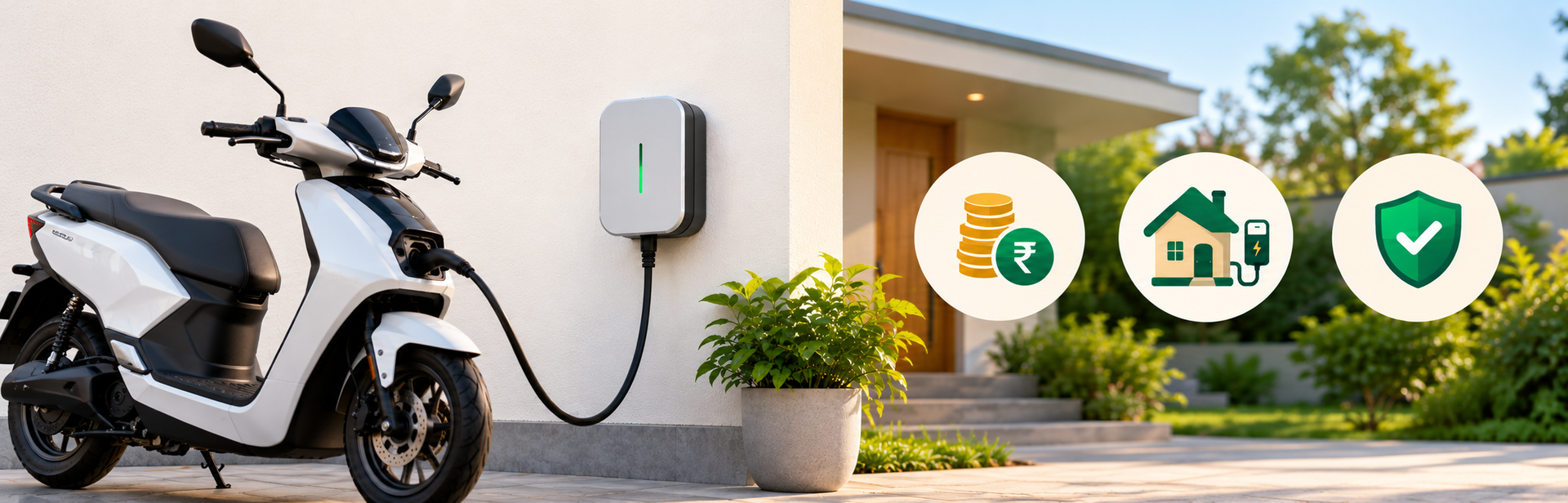
How to Charge an Electric Vehicle at Home: Costs, Setup & Safety Tips
- Published on Nov 27, 2026
- Read Time 7 mins
-

Plugging in your EV overnight and waking up to a “full tank” every morning for less than the cost of a cup of coffee is an upside of EVs. Though public DC fast chargers get all the marketing hype, home charging is the real spine of electric mobility. In fact, home charging for EVs powers above 80% of all EV miles driven globally.
Turning your parking slot into a personal, high-efficiency refuelling station can cut your per-kilometre running costs by almost 85% compared to petrol or diesel vehicles. However, setting up a safe home EV charging station in India needs careful planning. From electrical load limits to DISCOM meter rules and hardware choices, even your earthing setup counts.
Here’s a complete plan for EV home charger installation:
Level 1 vs Level 2 Wallbox for Your Home Setup
Start by choosing the correct AC EV charger category based on your daily driving range:
- The Level 1 Portable charger (15A/16A socket) has a power output of 2.3 kW to 3.3 kW AC. It plugs directly into a heavy-duty, grounded 3-pin power socket that’s the same outlet used for air conditioners or geysers.
As for charging speed, it adds roughly 15-20 km of range per hour. A full charge for a 30-kWh passenger car takes 12 to 15 hours. Also, this Level 1 portable charger is best suited for EV 2-wheelers, 3-wheelers, and low-mileage car owners who drive under 40 km daily.
- The Level 2 Smart AC wallbox has a dedicated circuit with a 7.4 kW single-phase and 11 kW/22 kW three-phase power output. It’s a permanently mounted wall charger linked directly to your home’s main distribution board via heavy-duty copper cabling.
Expect 35-50 km of range per hour, with a full charge for a 30-45 kWh EV battery taking 4-7 hours. Consider it if you’re a high-mileage commuter, commercial fleet owner with fast overnight turnarounds, or a multi-EV household.
Key Takeaways
Several Indian states offer subsidies under local EV policies (such as Delhi's ₹6,000 capital subsidy for early chargers). This significantly drops the installation cost of a Level 2 wallbox in residential apartments and private homes.
Step-by-Step Installation and DISCOM-Sanctioned Load Process
Follow this checklist for a fully legal and grid-compliant home EV charging setup:
Step 1: Calculate Your Sanctioned Load Capacity
Your sanctioned load (printed on your monthly electricity bill) is the maximum power your DISCOM permits you to draw simultaneously. A 7.4 kW Level 2 wallbox requires approximately 8 to 10 kW of sanctioned load headroom so it doesn't trip your main switch when running alongside household ACs or water heaters.
Step 2: Apply for a Load Enhancement or a Dedicated EV Meter
If your current sanctioned load is insufficient (e.g., only 3 kW or 5 kW), apply online through your DISCOM portal for a Sanctioned Load Enhancement. Alternatively, states like Delhi, Maharashtra, and Karnataka allow consumers to apply for a separate Dedicated LT EV Tariff Meter. This often includes special off-peak EV charging rates.
Step 3: Run a Dedicated Circuit (No Daisy-Chaining)
Never tap into an existing air conditioner or geyser wire. A licensed electrician must run a brand-new and uninterrupted dedicated circuit (using 6mm² or 10mm² copper cable) directly from your main distribution board (DB) to the parking bay.
Step 4: Secure RWA / Housing Society Approval
RWAs cannot arbitrarily reject EV charger installations in designated parking spots under Central Electricity Authority guidelines and urban housing norms. Provide your apartment board with a certified electrician's site feasibility report to confirm dedicated cabling and individual meter connections.
FAQs
How to ensure safety for EV home charging setups?
Keep the earthing resistance below 5 ohms and maintain a dedicated RCCB/RCD protection. Also, keep a weatherproof enclosure (IP54/IP65) and avoid unrated extension cords.
Can I charge my EV using home rooftop solar panels?
Yes. Pairing a rooftop solar system with your Level 2 wallbox allows you to charge your vehicle using self-generated green power during daytime peak hours, dropping your net per-kilometer fuel cost to near zero.
Also Read: Simple Comparison of EV-2W Running Cost vs Petrol Scooter Cost