
Rooftop Solar Maintenance: What Homeowners Often Forget After Installation (With Suggestions)
- Published on Sep 03, 2026
- Read Time 7 mins
-

Ignoring post-installation maintenance will always trigger a gradual, often invisible decline in your energy output. Though rooftop solar systems guarantee reduced household or factory operational expenses, there’s a misconception that the absence of moving parts in solar photovoltaic (PV) panels requires no operational care.
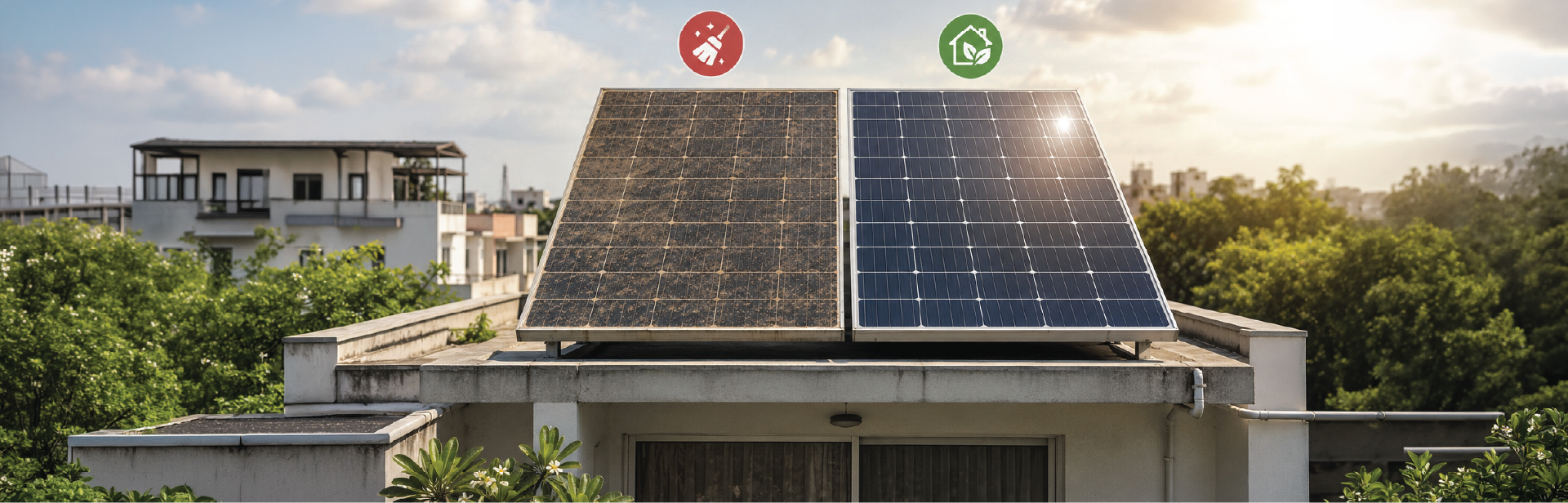
Solar panels keep collecting dust, bird droppings, or industrial soot. Also called “soiling”, these particles block sunlight from reaching the silicon cells. Studies show that uncleaned panels can lose 10%-25% of their power-generation capacity in high-dust regions within just a few months. Such a drop directly eats into your solar efficiency and extends your payback period unnecessarily.
Here’s what you can do to maximise your eco finance plan and treat your rooftop solar array as an active power plant that needs preventative care.
Understand the Chemistry of Cleaning (Dust vs Cementing)
Most owners of green homes assume a quick spray with a garden hose is sufficient. While loose dust washes away easily, hard water or environmental pollution can cause "cementing". This is when particulates bake onto the glass surface under intense sunlight.
- The Right Method: Clean panels early in the morning or late in the evening. Spraying cold water on panels baked by the afternoon sun can cause thermal shock and occasionally crack the protective tempered glass.
- What to Avoid: Never use abrasive sponges, metal scrapers, or high-pressure washers, which can strip the anti-reflective coating or damage the panel seals. Stick to a soft microfiber hand tool. If your local water supply is hard (high in calcium), use distilled or demineralized water to avoid leaving white scale deposits that block light.
Also Read: Understanding Subsidies and Incentives for Rooftop Solar in India
Inspect the Inverter
The panels surely capture your power source; however, the solar inverter does the heavy lifting by converting direct current (DC) into usable alternating current (AC). It’s most exposed to wear since it does the actual work of making the energy usable for your appliances.
Homeowners frequently forget to check the inverter’s physical environment. Note that inverters generate heat during peak production hours and require high ventilation. Ensure that storage boxes or household debris aren’t blocking the inverter’s cooling fins or vents. Also, get into the habit of checking the error logs or status LED lights weekly. Solid green light indicates optimal performance, but flashing amber or red codes may indicate installation faults or issues with grid synchronisation.
Check Shading and New Obstructions
A rooftop solar setup that was completely clear of shadows during your initial installation in January may not stay that way by July. Since the sun’s angle changes throughout the year, unexpected shadows can keep appearing through nearby trees or newly constructed neighbouring properties.
Keep in mind that solar panels are wired in strings. This means that a shadow covering just 10% of a single panel can choke the electricity flow of the entire string. This will severely reduce the solar equipment’s daily power generation capacity. Consider walking your roof quarterly at noon to ensure that no new foliage or structures are covering your solar array’s sunline.
Also Read: Calculate the True ROI of Rooftop Solar Systems
Perform Digital Audits to Track Generation Data
The easiest way to spot a maintenance issue before it ruins your monthly utility bill and extends your solar system loan duration is through active data monitoring. Most modern solar setups come with a smartphone app that tracks daily, weekly, and monthly kilowatt-hour (kWh) generation.
Rather than just looking at the daily total, compare your current month's generation against the baseline data from the same month last year. If your region experienced identical sunny weather but your generation metrics dropped by 15%, you’re probably dealing with either severe soiling or a spoilt system component.
Maximise Energy Savings with Ecofy
FAQs
How often should I clean my rooftop solar panels?
In most parts of India, a biweekly or monthly cleaning schedule is ideal, especially during dry, dusty winters and the summer pre-monsoon period.
Is it safe to clean the solar array myself?
For single-story homes with easy access to a flat roof, DIY cleaning is safe, provided you use long-handled soft squeegees and never step directly on the modules. For steep, pitched roofs or multi-story setups, hire a professional solar cleaning service.
Does a drop in efficiency mean my panels are permanently damaged?
Not necessarily. Most performance drops are caused by reversible factors like heavy dust or temporary shading. If output remains low after cleaning, contact your installer to run a diagnostic on your strings and inverter.